Purpose
To adapt PRINCE2 to any project.
- Tailor PRINCE2 to suit the project !
not increase the complexity in the project to suit PRINCE2. - Processes and themes can be tailored. However the principles cannot be changed, since they are principle to PRINCE2.
Definition
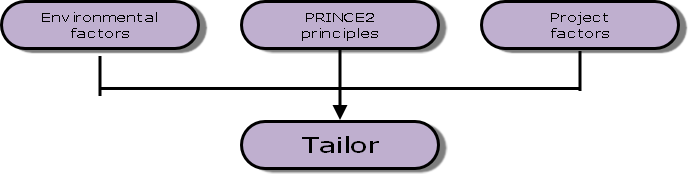
Tailoring is done by the Project Management Team to adapt the method to the context of a specific project. It is about adapting the method to external factors; thinking how to apply the method and then using it with lightness.
Principles
The principles are universal, the will always apply and are not tailored !
The principles will be of guidance when adapting themes and processes without losing their value.
Environmental factors:
- Multi organisation
- External customer/supplier
- Corporate standards
- Within a programme environment
- Organisation maturity
- Terms and language
- Geography
- Organisation culture
- Project priority
- …
Project factors:
- Project scale
- Solution complexity
- Team maturity
- Project type and lifecycle model
- …
Tailoring:
- Adapting the themes through the strategies and controls.
- Incorporating specific terminology / language.
- Revising product descriptions for the management products.
- Revising the role descriptions for the project roles.
- Adjusting the processes to match the changes in responsibilities and management products.
- Record the “tailoring” in the Project Initiation Documentation.
Approach to Tailoring
Themes
Usually the method of a theme is not modified. Environmental and Project factors are incorporated into the project strategies (Risk Management, Quality Management, Configuration Management and Communication Management) and controls. Relevant corporate or programme policies and standards are captured here as well.
Procedures can become more or less formal. The level of control required will influence the frequency and formality of monitoring, reviewing and reporting.
Terminology and language
Each organisation can incorporate their specific terminology / business language into the PRINCE2 method. Substituting these specific terms will improve understanding and acceptance in the corporate or programme organisation.
Adapting management products
The product description outlines provided by PRINCE2 may need to be adapted or a customised template to be provided in the process of tailoring PRINCE2.
- Management products may be combined.
Adapting roles
The project organisation structure needs to be considered for individual projects. Some roles can be combined or roles can be shared between persons. Some responsibilities may move from one role to another. This could be the case when junior staff is not (yet) capable for some responsibilities.
- Project Manager may fulfil Team Manager role.
- Project Manager may fulfil the Project Support role.
- There may be a simple Project Board.
Adapting the processes
All the activities in a PRINCE2 process need to be done; however responsibilities for performing these activities may change and references to management products may change.
- The number of delivery stages can be reduced.
- Align PRINCE2 to specialised lifecycle models to create the specialist product, such as Agile methods or Stage-gate process.